Sunday, March 23, 2008

It Ain't Tru Till It'd Been Foe-toed


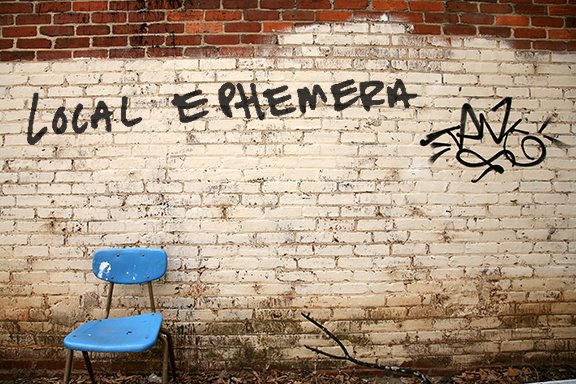
Went to the packed launch party at New Street for this new rag.


This post requires no words, it'll just be foe-toes (of our illusionairy world).


Wait, I must interject here (self importance taking over).... this one's great
Child psychology: discernible as a four-eyed cat.


Some guy at the party told me the propagation of images and information via new media is, or already has, destroyed any possibility of an original moment, idea, or thing.


Damn those blogs.

Friday, March 21, 2008

In Small Packages


Last Thursday I made my way over to the new lil Opal Gallery in lil 5 points for the opening of "Color Fields: an instant exhibition," a group show of Polaroid photographs. It was my first time to Opal and I was eager to see the space after learning that the ingenuity of architects Brian Bell and David Yokum, of Bldgs.org, were employed for the design the space. These are the guys also behind the renovation of Whitespace and this slick house.


One of the unique aspects of the one room space is that every wall can be viewed from outside of the gallery through the all-glass facade. It creates a nice transparency for passers-by to be able to view shows, even when the gallery is closed, a bit like window shopping but more like window perusing. It seems like a space ripe for shows incorporating public interaction.


The show, of 13 artists captivated by Polaroid film, was curated by Stephanie Dowda and presented by the collective Click Clique. The show was arranged in rows by color value to represent the color spectrum wrapping around the three walls and each grouping was the work of a different photographer.


I was torn between loving the simplicity of the presentation, which complimented the space and engaged the shape of the instant photographs perfectly, with wishing I had more information in the form of name labels. But in retrospect I think the ambiguity of the artists (which I am sure could have been easily rectified if I wasn't too lazy to ask for a show list) actually benefited the presentation of the work. Because all of the artists are using such a standardized format, it was interesting to walk around the room and begin picking up on slight nuances in style, subject matter, and camera handling to develop my own reading of these narrative-rich works.


People hiding their faces in rouge.

Some guy with orange hair took a picture of me taking pictures.


Blues and Greens. A picture of a picture of a picture.

While coincidental in timing, this shows carries extra impact due to Polaroid's recent announcement to end production of their instant film in 2009. It's hard to image a world without Polaroid film and with the resurgence in popularity I wish Polaroid had held out just a little longer. Then again, at $1 a shot, how can they compete with digital? Polaroid needs to move on towards creating a digital camera that captures the same great saturated colors and toy camera feel of the real thing, because there really is no substitute.


This series of colors fields was a nice juxtaposition to the majority of bright figurative work.


Makes me think of Tillman's Concord series


except without the planes. These work really well together.


Stephanie Dowda eyeing the art (or posing uncomfortably at my insistence)


This is a great shot.


Also brings to mind the (Nan Goldin meets street art meets privileged upbringing) Polaroids of this puffery punk.


Yellow. These three are awesome together.


Show is up until April 2nd 2008, go check it out. And at only $30 a pop, start yourself an art collection.
Wednesday, March 19, 2008

Gold Leme Palms


I'd forgotten all about the last $10 I dropped at the Earl


until I hung out with Hanyun and was reminded of the unspoiled pictures sitting on my camera.


Beach House. They sort of sound like an empty old beach house in the winter, maybe one on Pawley's Island, that creaks with the wind and the sound of distant waves vibrate against the windows. But they're from Baltimore.

Lead singer Victoria Legrand seemed much more coherent than the last time I saw her (last year I spent the entire concert breathlessly waiting for her swaying body to keel over the keyboard) but I would have to say their live performances aren't all that enthralling.


Far more interesting are the nutjob music videos which I am fascinated by much like watching earth worms working their way across the sidewalk.


I'm not sure what that's suppose to mean


but whenever there's a beach house, there's gotta be palm trees.

Monday, March 17, 2008

Two Thousand Pies


The Sunday after them tornadas was beautiful.


Who knew tornadoes actually went through cities? I was under the false impression living in an urban jungle protected one from such natural disasters. Good thing I was running late for the birthday party at Trader Vics or my car would be getting more than a wheel bearing replaced this week.


I went over to Whitespace, which I was happy to see had survived unscathed, to hear Fereydoon Family give a talk about his show "Stepping Blind." (Previous post here)


Family, his professorial skills coming into play, gave an excellent talk that turned into a very in depth conversation with the crowd. People had a lot to say about this work and it was apparent the concepts and intentions were wide open for a variety of interpretations.

Family began the talk by saying "I can tell you all about these pieces but I cannot tell you what they mean." I think that is the perfect way to begin an artist talk, for the artist to relinquish a control over the perception of their own art, to admit, or even better, to relish, in the esoteric nature of good art.


As a physicist, Family is interested in physical objects, the human condition, psychology, and as a student of art history, Family is curious as to how something physical can "transcend into art." The long history of portraiture, the different roles the artist and subject have played, and the changing purpose of the portrait during different periods of art, inspired Family's own exploration into the notion of portraiture in today's society. Family used what he calls "mass media documents," these are not snapshots but "formal objects" collected from newspapers, corporate newsletters, etc.


Family's action of painting over the faces and bodies with white-out was, Family countered, not an "intrusion" but was an "honest" gesture. He thinks of them as "psychological x-rays", in effect erasing information to get at something deeper. For me, if these gestures serve to unveil a truth it pertains to our relationship, as people, to mass produced images of strangers and the way in which the inauthenticity of the image becomes a barrier between the viewer and any feeling of affinity towards the subject. Family breaks down this barrier with his own personal imprint.

For me, Family's masking of the face makes the image more accessible. Portraits of strangers are most engaging and repelling in the details of the face, which is laden with so much information and identity it is hard to see beyond it. It's one reason photographs of people are one of the most difficult subject matters in art to sale. Art collectors are uncomfortable with the idea of having a realistic image of a stranger on their wall. Bringing this image into their home, living with it daily, is too intimate. The buyer is unable to get beyond the fact that this is indeed a real person and look at the photograph for the qualities it holds as a piece of art. This type of intimacy is abruptly halted by Family, who replaces it with his own artistic response, his own retooling of authenticity. By doing this the viewer is able to walk through the gallery without feeling the uncomfortable gaze of strangers but are given their own foothold into contemplating the image.


It's interesting that this action can be interpreted to imply so many different motivations and emotions. Jerry Cullum compared the brush strokes to "Chinese Calligraphy" and Felicia Feaster, in the Creative Loafing review "Lashing Out" compared them to "expression[s] of sublimated anger," acts of "violence" suggesting "skeletons."

I found them more playful than anything, but this opinion could be biased by knowing Family and his tendency for light hearted exchanges of ideas instead of fits of rage. Artists Julia Hill and Even Levy both pointed out that scale has a lot to do with how brutal the images are interpreted. Because Family painted these on a very small scale instead of painting directly onto the blown-up images, his own process was more delicate than aggressive, more nimble than forceful.


At the risk of sounding like I think "Another Country" is the sun with which all other Atlanta art shows orbit, I think it is a great coincidence that these two exhibitions are showing in Atlanta simultaneously. As someone very interested in photography and the function of the image in the context of our present day tech-savvy culture, both Family and McCallum/Tarry are challenging and manipulating the photograph through very personal methodologies. Both artists are using images completely independent of the artists (i.e. taken by someone else for a function other than fine art) and meditating on these images, turning them into personal anecdotes that represent their own interpretations or relationships to those images (and people or events at large).


Artist Julia Hill with Susan Bridges.


Julia has got this cool tattoo that greatly resembles one of her installation sculptures and she has started her own blog.


Fereydoon Family's show closes on Saturday March 29th 2008. Go.see.it.


And still can't get over this. Poor Cabbagetown, first Village Pizza closes, now this...

There is going to be a charity art auction, "Cabbagetown Relief," that will be held on Saturday March 29th, 2008 at Studio C 900 Dekalb Ave in Inman Park to raise money and services for the victims of the Cabbagetown Neighborhood and Cotton Mill resident community who have been displaced from their homes and/or lost property from the tornadoes.

Sunday, March 16, 2008

Uncle Remus


Walked over to Beep Beep Gallery to check out "Br'er," a new show of collaborative paintings by Michi and Dosa Kim.

"Jockey Free"

The paintings are a response to Uncle Remus's stories of Br'er Rabbit and Bannerman's stories of the Little Black Sambo. Appropriating characters and exploring the darker social implications of the stories. Interestingly, this show is a sort of parallel to McCallum and Tarry's show "Another Country" currently at Kiang Gallery, albeit completely different in style and scope, the show statement states "Br'er is the conflict of two artists from very different ethnic backgrounds, disciplines, and design philosophies collaborating in an obvious contrast and clash." Like "Another Country," it is the contrast between the artist's ideology and art-making which give the works such a multi-layered intrigue.


"Jockey Free" detail

The Uncle Remus stories seemed to also serve as a starting off point for a broader analyzing of children's stories, i.e. the inclusion of mickey mouse ears, and present day social tensions. Seeing this reminds me of Beep Beep's past Nostalgia" show, which any of these paintings could have fit perfectly into and added that missing element of skepticism and critical commentary.


"Ghee From India"

When I think back on Uncle Remus I can only remember my Dad's gripping performances of the animated southern drawl, definitely his most inspired impersonations at any bedtime reading, and my own amusement and anxiety over what I saw as that rabbit's recklessly dangerous behavior (I was a rather timid kid).

It's unsettling what caricatures can be so entertaining for kids, yet were inspired from exaggerated stereotypes and narrowed minds. The artist's state that the show was "inspired by children's stories that have been appropriated and misused as propaganda to perpetuate cultural stereotypes or beliefs, robbing the original story of its youthful nature."

The origination of the Uncle Remus stories is an interesting layering of cultures and interpretations in themselves, after doing a little wiki research, it appears the stories derived from Cherokee mythology and "storytelling traditions in Central and South Africa", later adopted into African American folktales, written down by Theodore Roosevelt's Uncle, published by Joel Chandler Harris, and later interpreted, in a saccharine sweet sort of way, by the unavoidable Walt Disney.

"Ghee From India" detail

As image rich and dynamic as these paintings are (see "Stay Cool Br'er" below) I found the inclusion of text unnecessary. I am biased though by an aversion to seeing text on paintings, which for me is too literal a device, carrying too concrete an interpretation, it inevitably distracts. It's a bit like the way Polygraph tests are considered inadmissible evidence in court. Because these tests cannot be proven to be 100% accurate always (what can really?) they are deemed too influential for a jury who would be unable to consider all other evidence independently when the implied credibility of the polygraph tests can so easily sway opinion. When it comes to the viewer's interpretation of a painting, they have no choice but to take the text into account.

Having said that though, it's hard to imagine these paintings without the scribbled writing, so there you have it.


"Stay Cool Br'er"

"Ahem!" said Brer Rabbit loudly, wondering if the Tar Baby were deaf. "I said 'HOW ARE YOU THIS MORNING?"

The Tar Baby said nothing. Brer Fox curled up into a ball to hide his laughter. His plan was working perfectly!

"Are you deaf or just rude?" demanded Brer Rabbit, losing his temper. "I can't stand folks that are stuck up! You take off that hat and say 'Howdy-do' or I'm going to give you such a lickin'!"

"I'll learn ya!" Brer Rabbit yelled. He took a swing at the cute little Tar Baby and his paw got stuck in the tar.


"Stay Cool Br'er" detail

"I've got you this time, Brer Rabbit," said Brer Fox, jumping up and shaking off the dust. "You've sassed me for the very last time. Now I wonder what I should do with you?"

Brer Rabbit's eyes got very large. "Oh please Brer Fox, whatever you do, please don't throw me into the briar patch."
"Maybe I should roast you over a fire and eat you," mused Brer Fox. "No, that's too much trouble. Maybe I'll hang you instead."

"Roast me! Hang me! Do whatever you please," said Brer Rabbit. "Only please, Brer Fox, please don't throw me into the briar patch."

"Change Come"

This painting is awesome. "Change Come"exemplifies the dangerous implications lurking beneath the lamb-skin of children's stories. There is a brooding evil, quick as Br'er rabbit, sticky as the Tar Baby, a face off between laughter and darker intentions.


"Change Come" detail

And speaking of tar, the black line work of the painting has a glossy, crackled, look about it that really feels like dried tar. The use of color in tandem with the line work increases the movement and intensity, building a stage around the bold forms, adding stream of consciousness, kind of like the mind's illustration of the story told.


"Change Come" detail

"Br'er" is up at Beep Beep Gallery until March 23rd 2008. Check it out while you still can.

Friday, March 14, 2008

Magenta Mad

I've been pretty enamored with the energy of Santogold for the past six months, which doesn't seem to be much of a choice considering how addictive their songs are, especially L.E.S. Artistes, which they have just released this bizarre video for.... It's not exactly what I was expecting....


Question is, when are they going to release an actual CD in the States? Ever? The buzz on this band will die before the album ever arrives at Criminal.

Plan on hitting repeat.